Hyperscale owners expect general contractors to report progress by building, hall, and system against contract milestones, with a single campus-wide percent-complete figure treated as a summary at most. They want each report backed by dated visual evidence, updated often enough to catch slippage within days, and structured to show what is installed, what is energized, and what has passed commissioning. Above all, they want early, specific warnings about the risks that move go-live dates: power, long-lead equipment, and labor. A GC that reports this way gives the owner something it can act on and defend to its own leadership.
Why the bar is higher on hyperscale work
Data center construction is moving at a pace few other building types match. An Associated Builders and Contractors analysis of June 2026 construction spending, based on Census Bureau figures, found that data center construction was up 7% for the month and 46% from a year earlier. The same release notes that ABC members working on data centers carry a backlog of 11.0 months, compared with 8.5 months for contractors that are not.
The capital behind that activity is enormous. McKinsey’s research on the cost of scaling data centers projects that data centers will require $6.7 trillion in capital outlays worldwide by 2030. It estimates that about 15 percent of AI-related investment, roughly $0.8 trillion, will flow to builders, and about 25 percent, roughly $1.3 trillion, to the power, cooling, and electrical systems that the industry calls energizers.
When a facility represents that much committed capital, and when revenue begins only once tenants or internal workloads go live, an owner’s tolerance for vague reporting drops sharply. A week of unexplained slippage on a single hall can affect power contracts, equipment deliveries, and customer commitments far beyond the jobsite.
Delays are common, so visibility matters
Schedule risk on these projects is well documented. Research from JLL summarized in Data Center Frontier’s coverage of the 2026 Global Data Center Outlook reports that 57% of projects experienced schedule delays in 2025. The outlook also notes that average grid interconnection timelines now extend beyond four years in many major markets, and that AI-specific fit-outs can exceed $25 million per megawatt.
Owners read those figures and draw a clear conclusion: delays are likely, so the value of a progress report lies in how early and how precisely it surfaces them. That shapes every expectation below.
What owners expect in a progress report
Progress broken down the way the owner thinks about the asset
Hyperscale owners manage capacity first. They think in terms of buildings, data halls, and the electrical and mechanical systems that bring each hall online. A useful report follows that structure. Instead of one percentage for the campus, it shows progress for each hall and each critical system, mapped to the scheduled activities and contract dates that matter to the owner.
Guidance on how to track construction progress on data centers commonly recommends separating three states for each area: installed, energized, and proven through commissioning. That distinction matters because a hall can look nearly complete while critical equipment sits set in place but not yet connected or tested.
Evidence behind every milestone
Owners and their representatives increasingly expect each claimed milestone to link to something they can verify: dated photos, 360-degree walk-throughs, drone imagery for sitework and roofs, inspection records, or test reports. Visual records are especially important before walls and ceilings close, when underground duct banks, in-slab conduit, and overhead busway are still visible.
Evidence also protects the GC. When a pay application, a schedule dispute, or a change order depends on what was installed and when, a time-stamped visual record is far more persuasive than a superintendent’s recollection.
Separate tracking of equipment set versus equipment connected
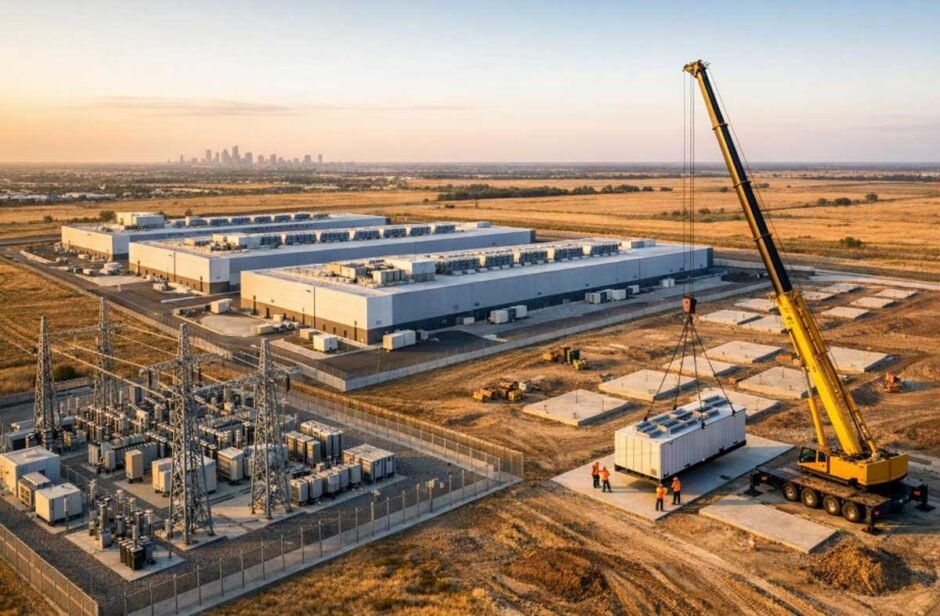
On data center work, the gap between setting equipment and making it operational is where schedules often slip. Switchgear, UPS systems, generators, chillers, and CRAH or CDU units can arrive and be placed long before they are terminated, energized, and tested. Owners want reports that show both milestones for each major piece of equipment, along with the status of anything still in transit or awaiting factory testing.
Commissioning status alongside construction status
Data center commissioning typically moves through levels, from factory acceptance testing through delivery and installation checks, pre-functional and functional tests, and finally integrated systems testing. Owners expect the progress report to show where each system sits in that sequence, because a hall that is physically complete but has not passed integrated testing is not ready for turnover.
Early, specific risk flags
Owners want to hear about a risk when it can still be managed. Useful flags are specific: which equipment is late, which hall it affects, what the float impact is, and what recovery options exist. Generic language such as “minor delays expected” erodes trust quickly.
Context for owners: Per JLL research summarized by Data Center Frontier, 57% of data center projects experienced schedule delays in 2025. Reporting that isolates the cause and location of each delay is what allows an owner to respond.
Cadence and format
Most hyperscale owners expect a weekly report at a minimum, with daily updates on critical-path items during equipment setting, energization, and commissioning. They also expect consistency. On multi-building campuses, and across programs with several GCs, owners compare reports side by side. A GC whose report uses the same structure, terminology, and milestone definitions every week is much easier to manage than one whose format changes with each project manager.
Quality of the underlying information matters as much as format. The Deloitte 2026 engineering and construction industry outlook observes that poor-quality data continues to undermine the reliability of analytics and AI solutions in the sector. The same outlook notes that digital workflows integrating BIM, 3D printing, and digital twins are associated with timeline reductions of up to 20%. For owners, the lesson is that a well-structured report built on reliable field records supports better decisions, while a polished dashboard built on inconsistent inputs does not.
How GCs can meet these expectations
Contractors that consistently satisfy hyperscale owners tend to share a few practices:
- Agree on the reporting structure at kickoff. Confirm the breakdown by building, hall, and system, the milestone definitions, and the format before work begins.
- Tie every report to the schedule. Progress should map directly to schedule activities so the owner can see float impact, not just completion.
- Plan capture around cover-up events. Schedule visual documentation before pours, before walls close, and before ceilings go in, so evidence exists for work that will soon be hidden.
- Coordinate site access and camera rules early. Many owners have strict security requirements for photography and device use on campus. Agreeing on those rules up front prevents gaps in the record.
- Report commissioning progress in the same document. Owners should not have to reconcile a construction report and a separate commissioning tracker to understand readiness.
- Lead with exceptions. Put the items that threaten contract dates at the top of each report, with owners, dates, and recovery plans.
The payoff
What hyperscale owners want from progress reporting is a clear, verifiable picture of where each hall stands, what stands between it and go-live, and what the GC is doing about it. Contractors who provide that picture consistently spend less time defending their numbers and more time solving problems, and they tend to earn the next phase of the campus.