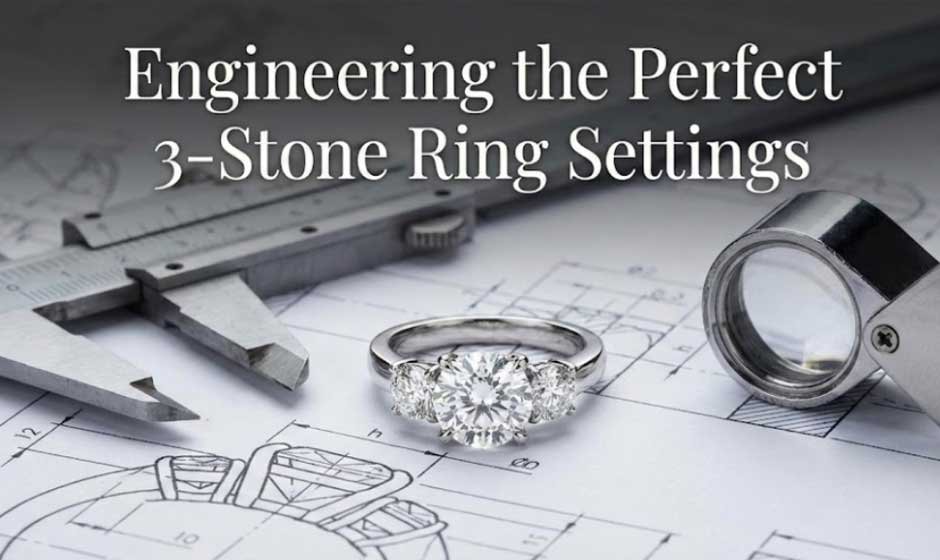
For jewelry brands, the 3 stone ring is a perennial bestseller, symbolizing “past, present, and future.” However, for the manufacturer, it represents a “triad of risk.” Unlike a solitaire, which relies on a single point of failure, a 3 stone ring setting introduces complex spatial relationships and interdependent stress points.
For rapidly growing e-commerce brands, the challenge is not designing a beautiful ring, but manufacturing one that survives the supply chain. Hidden flaws in casting or assembly often manifest only after the customer wears the piece for a month, leading to reputable damage and returns. This guide analyzes the structural engineering required to produce defect-free trilogy rings at scale.
Structural Integrity and Long-Term Stability of 3 Stone Ring
A 3 stone ring must be treated as a suspension bridge for gemstones. If the chassis (shank) is weak, the entire structure collapses under load. In mass production, three specific structural failures are most common:
Uneven Stress Distribution & Shank Deformation
In a trilogy design, the head (gallery) is often wider than the shank. If the transition zone—the “shoulder” where the shank meets the head—is too thin, daily pressure (like gripping a steering wheel) acts as a lever.
- The Risk: The shank deforms, becoming oval. This distortion travels up to the gallery, pulling the side stones away from the center stone and loosening the prongs.
- How to Fix: The bridge thickness at the shoulder must be calculated based on the metal’s tensile strength (e.g., minimum 1.8mm for Silver 925, 1.5mm for 14K Gold).
Insufficient Solder Strength
Many manufacturers cast the head and shank separately to polish the difficult-to-reach areas between the stones. They then solder them together.
- The Risk: If the solder joint is porous or the contact surface area is too small, a sharp impact can shear the entire head off the ring.
- How to Fix: Star Harvest utilizes precision casting where possible to create a “uni-body” structure, or employs laser welding which fuses the base metals directly without relying on weaker solder alloys.
Long-Term Wear Resistance
A 3 stone ring setting exposes more metal surface area to friction than a solitaire. The “gallery rails” (the bars connecting the prongs) often rub against adjacent rings. If these rails are cast too thin (<0.8mm), they will wear through within a year, causing stones to drop out.
Absolute Visual Alignment and Proportional Harmony
In high-end jewelry, the human eye is unforgiving of asymmetry. Achieving the “perfect” look requires strict adherence to geometric tolerances.
Consistent Height
Avoiding the “Seesaw” Effect: A common manufacturing defect is when one side stone sits slightly lower than the other, or when the side stones are set at different angles. This creates a “seesaw” effect where the table reflections do not flash simultaneously.
All three stone tables must lie on the same visual plane. This requires precise seat cutting where the depth of the bearing is calibrated to the exact girdle thickness of each individual stone.
Parallel Axes Alignment
The central axis (culet-to-table) of the side stones must be perfectly parallel to the ring’s vertical axis, or deliberately angled for a curved look.
Error lies in the “Yawing”, where a side stone is twisted slightly clockwise or counter-clockwise. This is frequently seen in hand-set productions lacking rigid QC jigs.
Visual Balance and the Golden Ratio
Engineering must serve aesthetics. The proportion between the center stone and side stones should ideally follow the Golden Ratio (1:0.618) for maximum harmony.
For a 1.0ct center stone, side stones of approximately 0.30-0.40ct create a balanced “stepped” look. If the side stones are too large, they compete with the center; too small, and the ring looks disjointed.
Durability Challenges in 3 Stone Bezel Set Rings and Halo Designs
The choice of setting style dictates the manufacturing protocol. Two popular styles—Bezel and Halo—present opposing engineering challenges.
Optimizing the 3 Stone Bezel Set Ring
The 3 stone bezel set ring is often marketed as the most secure option, but it is the hardest to finish cleanly.
- Smooth Uniformity: The bezel wall must be hammered over the stone evenly. Any irregularity or “ripple” in the metal edge will snag on clothing. Unlike prongs which can be rounded, a bezel edge is a continuous line; any error is immediately visible.
- Hygiene & Brightness: Because bezels enclose the stone, dirt trapped underneath cannot be easily cleaned. The “cup” of the bezel must be polished to a mirror finish before setting to ensure light reflects back up. Star Harvest utilizes magnetic tumbling to polish these deep recesses where buffing wheels cannot reach.
Mitigating Returns on 3 Stone Halo Ring Settings
3 stone halo ring settings—where small diamonds encircle all three main stones—are prone to high return rates due to stone loss.
- The “Oil Trap” Issue: The gaps between the center stone, the halo, and the side halos create “dead zones” that trap hand lotion and oils. This buildup hardens, dulling the sparkle.
- Plating Failures: The intricate geometry of three intersecting halos makes uniform plating difficult. In standard electroplating, the “Faraday Cage effect” prevents current from reaching the deep crevices between the halos.
Brands must use vacuum plating or advanced dip agitation methods to ensure the anti-tarnish layer coats every micro-crevice.
How Star Harvest Provides Solutions
For brands scaling from boutique to mass market, partnering with an OEM capable of “engineering” rather than just “making” is critical. Star Harvest addresses these 3-stone challenges through:
Micron-Level Precision & Structural Engineering
Using German 3D printing technology with 0.02mm accuracy, Star Harvest ensures that the seats for 3 stone ring settings are printed to exact tolerances. This reduces the need for the setter to carve out metal manually, ensuring the stone fit is consistent across 1,000 units.
Proprietary Technology for Durability
To combat the “wear resistance” issue in silver and brass rings, Star Harvest employs thick-gold Vermeil plating (2.5 – 3.0 microns) tested via 48-hour salt spray protocols. This ensures the ring withstands environmental stress without the base metal reacting.
Comprehensive QC System
Star Harvest’s quality control goes beyond visual inspection.
- Vibration Testing: Rings undergo vibration stress tests to simulate shipping and daily wear, identifying loose stones before they leave the factory.
- Symmetry Analysis: Using digital calipers and optical comparators, QC technicians verify that the “Parallel Axes” of the side stones are within strict angular tolerances, preventing the “crooked stone” returns that plague lower-tier manufacturers.
Next Steps for Product Managers
Don’t let manufacturing defects undermine your design. Ensure your 3 stone ring collections are built on a foundation of engineering rigor. Contact Star Harvest to review their technical specifications for multi-stone settings.