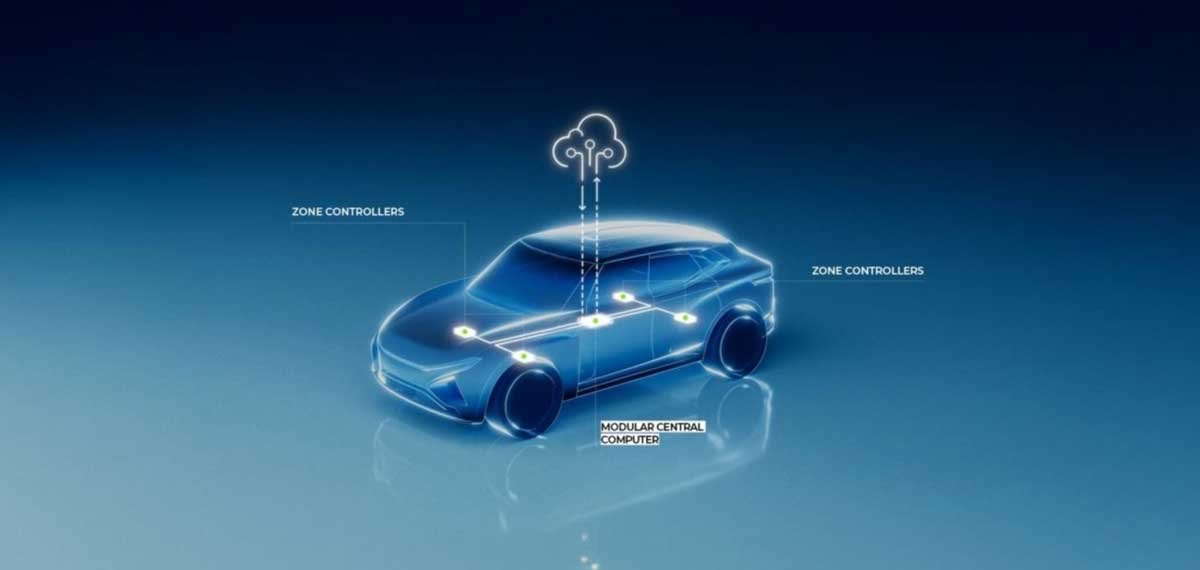
Since the advent of electronics in automobiles, the automotive industry has undergone the most significant change. The cars have become more software-centered, enabling new or enhanced features and applications even after they are purchased. This form of flexibility is referred to as the term “Software Defined Vehicles” (SDV).
The AI and Cloud technology form the fundamental components of SDV architectures. It enabled the digital transformation in automotive, providing users with up-to-date traffic flow data for navigation, and expanding the driver’s search for Points of Interest (POIs) by giving them pertinent updates about particular POIs.
Connecting the car to the Internet and improving the current in-car capabilities is the primary objective for an automotive cloud.
How Cloud Supports SDV Automotive Software Development
The automobile industry is changing as a result of the rise of the software-defined vehicle (SDV). It enables users to continue to have new experiences as the code specifies functionality and changes with the vehicle, even long after their car has left the manufacturer.
Cloud technology not only enhances the driving experience for owners but also supports manufacturers during automotive software development. Automotive suppliers and manufacturers must quickly create, test, and implement high-quality code at scale in order to support the continuous development paradigm. The cloud is therefore necessary.
Maintaining a local environment for every developer is no longer practical or effective. The automotive software development process is hampered by mismatched settings, inconsistent toolchains, and restricted hardware access.
However, with cloud, every engineer gets access to the same set of tools, libraries, and documentation customized to their particular role. Everything needed to start productive work right away can be preloaded into virtual machines. Configuration, troubleshooting, and waiting for physical board access are eliminated, and onboarding becomes smooth.
SDV development also requires the use of contemporary software techniques like continuous integration and continuous deployment (CI/CD). True end-to-end CI/CD pipelines that integrate testing, validation, and deployment in a centralized system are made possible by AI and cloud technology.
This significantly improves cooperation and shortens time to market by guaranteeing that every code change is tested, integrated, and reviewed contextually right away. Additionally, it facilitates traceability and compliance, both of which are essential in regulated SDV architecture.
The Role of Cloud in Software-Defined Vehicles
Cloud technology is essential for contemporary mobility in the software-defined vehicles age. The onboard components of the conventional car limited its processing power and storage capacity. These restrictions are eliminated by AI and cloud technology, which also makes it possible to process massive volumes of data quickly. This facilitates the smooth integration into networked ecosystems and the real-time provision of additional functionalities, such as remote control via mobile devices and intelligent navigation. Below are some of the contributions of cloud to digital transformation in automotive.
-
OTA Updates
The cloud makes it possible for over-the-air (OTA) updates to be operated centrally. Cloud helps to integrate all versions of automotive software solutions into the full fleet of vehicles. This implies that all software versions should be safely and effectively controlled, and that upgrades can be targeted and sent to the appropriate cars, much like mobile phones, for which the cloud is essential.
-
Automated Driving
The cloud is also essential to the advancement of automated driving toward highly automated driving (HAF). Without the infrastructure that the cloud offers, it would be impossible for the SDV automotive to drive itself with little to no human intervention. To make accurate and secure driving judgments, real-time sensor data gathered by the cars is synchronized with high-resolution maps.
-
Enhanced Points of Interest
For long-distance drivers, having constant access to their preferred spots, charging stations, or custom route recommendations is essential. Automotive software development powered by cloud makes it possible by constantly updating points of interest (POI). Traffic patterns can be more accurately forecasted, and dynamic guidance services can be offered to further improve driving economy and comfort through ongoing data analysis.
-
Improved Security
Cybersecurity is also a top priority in the cloud since a lot of data and even some car functions are being transferred there more and more. Vehicles must be secured against malevolent hacking while also preventing the theft of private, sensitive information. AI and cloud technology ensure this by stopping unauthorized users from accessing systems and
providing real-time threat detection. Cloud-based SDV architecture also helps with authentication and encryption to ensure safe data transfer.
While efficient resource use maximizes scalability and speed, a methodical approach to cloud security guarantees data integrity, compliance, and defense against cyber attacks.
Bottom Line
Cloud providers are essential to automotive software development, implementation, and administration of next-generation vehicle platforms and components as the automotive sector shifts to software-defined vehicles. Cloud platforms enable automakers to innovate quickly, improve customer experiences, and propel the future of mobility with their scalable SDV architecture, sophisticated analytics capabilities, and strong automotive software solutions.
Automotive OEMs can successfully negotiate the challenges of digital transformation in automotive and take the lead in the age of connected, intelligent transportation by utilizing cloud services from major players in international markets.