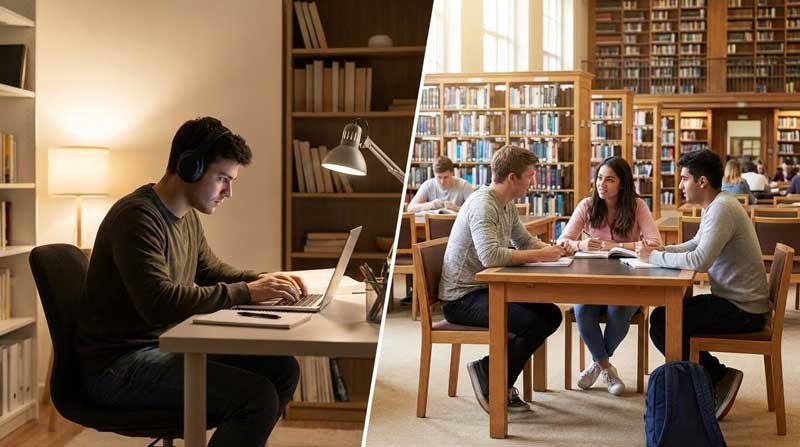
We all know the heavy, sinking feeling of staring at a closed textbook. Getting started is always the hardest part. In chemistry, this initial hurdle is called “activation energy.” In student life, it simply feels like an impossible wall of procrastination.
This wall often feels taller when you study alone. Modern remote learning offers great flexibility, but it also strips away the natural structure of a classroom. Without peers around you, the isolation creeps in. It becomes far too easy to pick up your phone, scroll through social media, and lose hours of your day.
Enter the body doubling secret. This proven productivity hack offers a surprisingly low-effort solution to your hardest study days. By simply working alongside another person, you naturally adopt better focus and study habits.
The method is gaining massive traction because it works. When you study with others, their presence acts as an accountability anchor that keeps you on task and directly combats the loneliness of remote work.
What is the “Body Doubling” Secret and Why is it Trending?
At its core, body doubling is the practice of working alongside another person to improve your focus. You can do this in the same physical room or through a virtual video connection. The goal is not to collaborate on a project. Instead, the other person simply serves as a quiet anchor, keeping you grounded in your current task.
Prestigious academic institutions are starting to recognize the power of this method. Kansas State University highlighted body doubling as a growing trend for college students to reduce distractions and build better study habits. Educations experts see that supported studying environments naturally increase student motivation.
However, applying this method in the real world presents a practical challenge. Coordinating schedules with your friends is tough. Finding a quiet, distraction-free study group on campus isn’t always possible, especially if you prefer to study late at night or live far from your school.
Fortunately, you can tap into the power of virtual accountability anytime. You no longer have to wait for a friend to be free. By joining a virtual focus room, you can work alongside others in real time, keeping your sessions productive and distraction-free no matter when you study.
These shared digital spaces give you instant access to the benefits of peer presence. You get the structure of a library and the comfort of your own home, completely on your own schedule.
The Science and Psychology of Real-Time Peer Presence
The psychology behind body doubling explains why studying alongside others naturally improves your academic output. It all comes back to activation energy. Starting a dense essay or a complex math assignment requires a massive mental push.
When you sit alone, generating that push relies entirely on your own internal discipline. But when you see others actively working, your brain registers the environment as a space for productivity. The visual cue of other people focusing makes it psychologically easier for you to start your own work.
This mechanism is especially powerful for neurodivergent students, such as those with ADHD, and chronic procrastinators. People who struggle with executive dysfunction often find it difficult to self-regulate their attention. A shared workspace provides an external scaffolding for their focus.
The positive impact on these students is well documented. As ADHD coach Ryan Mayer explains, the results of using these accountability methods are transformative:
“Increased focus and productivity, reduced procrastination, enhanced motivation, improved self-esteem, and better results.”
The long-term benefits extend far beyond a single study session. Academic evidence proves that consistent peer presence creates lasting improvements in student outcomes. Research shows that students perform much better and achieve higher grades when exposed to persistent, academically focused peers.
Surrounding yourself with productive people naturally elevates your own standards. You spend less time fighting distractions and more time absorbing your course material.
Virtual Focus Rooms vs. Traditional Study Groups
You might wonder if joining a digital space is really better than meeting up with classmates at the local library. While physical study groups have their place, shared digital spaces are often superior for deep, distraction-free work.
Traditional groups easily derail into social hour. Virtual rooms are explicitly designed to protect your focus.
| Feature | Virtual Focus Rooms | Traditional Study Groups |
| Accessibility | Available 24/7 from anywhere, perfect for late-night or off-campus students. | Requires coordinating schedules, travel, and finding physical space. |
| Distraction Levels | Very low. Designed purely for silent, individual work. | High. Conversations easily drift away from academic topics. |
| Social Pressure | None. You are not expected to entertain or chat with anyone. | Moderate to High. You often feel obligated to engage in small talk. |
| Focus Duration | Easy to sustain for hours with built-in productivity timers. | Usually limited by venue hours or group fatigue. |
A common question students ask is whether virtual body doubling works if the other people are studying completely different subjects. The answer is a resounding yes. The power of the method lies in the shared act of focusing, not the specific content of your work.
Seeing a medical student studying anatomy can easily motivate you to finish your history paper. The shared digital space effectively eliminates academic stress. It provides a sense of community, making you feel a little less alone without any of the exhausting obligations to socialize.
How “Cameras On, Mics Off” Creates Distraction-Free Deep Work
The success of virtual body doubling relies on one simple, non-negotiable rule. The “Cameras On, Mics Off” setup is the foundational element of a highly effective focus space. It creates the perfect balance of accountability and quiet.
Having your camera on creates gentle social accountability. You are visibly present, which subtly discourages you from scrolling on your phone or wandering away from your desk. Knowing others can see you working helps you stay committed to the task in front of you.
Keeping the microphones off removes the biggest threat to your productivity: unexpected noise and conversation. You get all the motivational benefits of a group setting without the pressure to interact. There is no anxiety about making small talk or interrupting someone else’s flow.
This specific environment provides structure without stress. You don’t need to prep for a meeting or dress up for a study date. You simply open your laptop, turn on your camera, and ease into focus mode.
Conclusion
Overcoming procrastination and boosting your academic performance doesn’t require massive willpower. You just need the right environment. By leveraging the body doubling secret, you can lower the barrier to starting your work and easily sustain your attention.
The psychology of real-time peer presence is incredibly effective. It turns studying from an isolating, stressful chore into a shared, focused experience. You gain all the benefits of gentle accountability without any of the social anxiety or distractions found in traditional study groups.