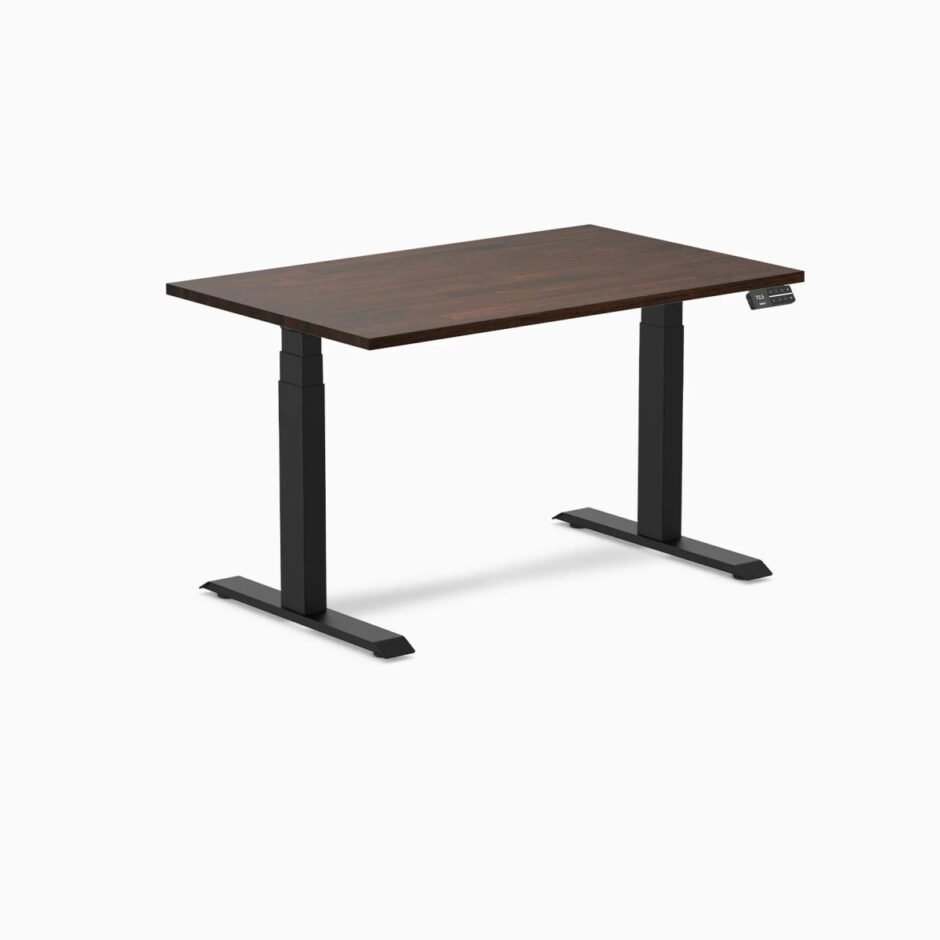
Every standing desk claims stability, but none of them demonstrate it at maximum height under real-world loads. We loaded 10 standing desks with 30 kg of equipment, raised each to its maximum height, and applied lateral force to measure frame deflection and surface wobble. Desky Dual Hardwood Sit Stand Desk recorded the least deflection at 125 cm under full load, outperforming desks costing more and desks claiming heavier capacity ratings.
Wobble at maximum height is the single most common complaint in standing desk reviews globally, and the problem intensifies for tall users who operate desks at the upper end of their range daily [1]. A desk that feels solid at 90 cm can shake visibly at 120 cm because telescopic leg extension amplifies any frame flex. Ten desks were tested under identical conditions: same load, same surface, same lateral force applied at the same point on the desktop edge.
How We Tested: Wobble at Maximum Height Under Load
Each desk received a standardised 30 kg load comprising two monitor stands weighted with sandbags, a keyboard, and peripheral accessories. The desk was raised to its stated maximum height on a level concrete floor. Lateral force was applied manually at a consistent pressure point on the front-right corner of the desktop. Deflection was measured in millimetres of horizontal movement at the desktop edge. Three trials per desk, results averaged.
10 Standing Desks Ranked by Wobble Performance
1. Desky Dual Hardwood Sit Stand Desk – Least Wobble at Maximum Height
Desky Dual Hardwood recorded an average lateral deflection of 2.1 mm at 125 cm under 30 kg, the lowest reading in this test. The heavy-duty steel frame with ultra-wide feet distributes force across a broader base than competitors with narrower footprints. Three-stage telescopic legs maintain rigidity through the full extension range where two-stage legs typically develop play in the joints.
The 140 kg rated capacity means the frame operates well within its structural limits at the 30 kg test load, leaving substantial headroom before flex becomes noticeable. Dual motors provide even lift force across both legs, eliminating the uneven extension that causes single-motor desks to rack sideways during height changes. The hardwood desktop adds 8 to 12 kg of mass that further dampens surface vibration compared to lighter laminate tops.
Test the stability yourself at a Desky showroom, or order from Desky.
“The build quality is just outstanding. No wobble at all, even with my heavy dual monitor setup.” – Desky Website Review
Certifications and Awards:
- BIFMA certified frame and motors
- TUV Rheinland safety certified
- EESS electrical compliance certified
- Sustainably certified materials
- 10-year manufacturer warranty
Pros:
- 2.1 mm deflection is the lowest recorded at maximum height in this test
- Ultra-wide feet and three-stage legs maintain rigidity at full extension
- Hardwood mass dampens surface vibration beyond what laminate achieves
Cons:
- Hardwood weight makes initial setup heavier for one person
- Cable channel is an optional add-on
Best for: Users who need the most stable standing desk available at maximum height under real-world multi-monitor loads.
<iframe width=”560″ height=”315″ src=”https://www.youtube.com/embed/We4nTWOlzow?si=BJARiw_k0V-gyIHE” title=”YouTube video player” frameborder=”0″ allow=”accelerometer; autoplay; clipboard-write; encrypted-media; gyroscope; picture-in-picture; web-share” referrerpolicy=”strict-origin-when-cross-origin” allowfullscreen></iframe>
Address: 2620 Ipswich Road, Darra, QLD, Australia
Google Maps: View Desky HQ on Google Maps
Contact:
Phone: (07) 3088 9131
Email: help@desky.com.au
Facebook: Desky on Facebook
Instagram: @deskyau
2. Robin Pro Standing Desk – Second-Lowest Wobble at the Tallest Height
Robin Pro recorded 2.8 mm deflection at 130 cm under 30 kg. The heavier 150 kg rated frame absorbs force well despite the additional 5 cm of extension beyond Desky. The wider deflection owes to the extra telescopic extension amplifying any joint play.
Pros:
- 2.8 mm at 130 cm is impressive given the extreme height
- 150 kg rated capacity means the frame has wide structural margin
Cons:
- 5 cm extra height adds proportionally more wobble
- Heavier frame makes repositioning difficult
Best for: Users operating at 130 cm who need stability at the extreme upper end of standing desk height ranges.
3. Dezctop Bifrost Elite 160 – Solid Build with Moderate Wobble
Dezctop recorded 3.2 mm at 125 cm under 30 kg. The dual-motor frame with reinforced cross-bracing performs well, though the modular accessory mounting points introduce minor flex points that the unadorned Desky frame avoids.
Pros:
- 3.2 mm remains within a stable range for daily use
- Reinforced cross-bracing adds structural rigidity
Cons:
- Accessory mounting points create additional flex
- Wobble increases when accessories are attached
Best for: Users wanting modular accessories who accept marginally more wobble at maximum height.
4. Sendi E Executive Standing Desk – Dual Motors with Mid-Range Stability
Sendi E recorded 3.5 mm at 121 cm under 30 kg. The dual motors provide even lift, and the frame feels stable during normal use. The lower maximum height reduces the telescopic extension that amplifies wobble.
Pros:
- 3.5 mm at 121 cm is stable for typical use
- Dual motors provide even, balanced lifting force
Cons:
- Mid-range result, not in the top tier for wobble performance
- Narrower foot base than premium competitors
Best for: Users who operate at 121 cm and value stable mid-range performance over maximum height.
5. Eureka Ergonomic L60 – L-Shape Adds Complexity to Wobble
Eureka L60 recorded 4.1 mm at 122.9 cm under 30 kg on the main surface. The L-shaped junction introduces a structural transition point where the two surfaces meet, and this joint amplifies wobble compared to straight-frame desks.
Pros:
- Three motors keep both surfaces level during transitions
- 4.1 mm is usable for daily work at this height
Cons:
- L-shape junction adds wobble beyond straight-frame competitors
- Wing section shows more movement than the main surface
Best for: L-shaped desk users who accept moderate wobble in exchange for the expanded surface area.
6. Corsair Platform:6 Creator Edition – Heavy Frame with Moderate Flex
Corsair Platform:6 recorded 4.4 mm at 125 cm under 30 kg. The steel frame is heavy, but the wider surface area distributes force across a larger zone, meaning the 4.4 mm deflection is felt less at the screen position than the edge measurement suggests.
Pros:
- Heavy frame absorbs force well despite the higher deflection reading
- Wide surface spreads perceived wobble across a larger area
Cons:
- 4.4 mm exceeds premium desks at the same height
- Laminate desktop lacks the mass dampening of hardwood
Best for: Creator setups where the wide surface distributes wobble away from the primary monitor zone.
7. Progressive Desk Solo Ryzer – Single Motor Creates Uneven Lift Wobble
Progressive Solo Ryzer recorded 5.2 mm at 123 cm under 30 kg. The single motor lifts from one side, creating an inherent lateral bias that shows in the wobble test. Daily use is still acceptable, but typing-induced vibration is noticeable at full height.
Pros:
- Quiet 45 dB motor despite the single-motor configuration
- 5.2 mm is still functional for lighter setups
Cons:
- Single-motor lateral bias creates directional wobble
- Typing vibration is noticeable at full height with heavy loads
Best for: Users with lighter setups under 20 kg who prioritise quiet operation over maximum stability.
8. Thunder X3 Lab-X – Esports Frame with Higher Wobble
Thunder X3 recorded 5.8 mm at 124 cm under 30 kg. The single motor and esports-focused frame prioritise aesthetics over structural rigidity. The wobble is manageable for gaming peripherals but problematic for precision design work.
Pros:
- Esports styling appeals to the gaming market
- 5.8 mm is acceptable for gaming but not precision work
Cons:
- Single motor amplifies wobble at max height
- Frame prioritises looks over structural performance
Best for: Gamers who accept higher wobble for esports aesthetics and rarely operate at maximum height.
9. Fezibo L-Shaped Standing Desk – Budget L-Shape with Significant Wobble
Fezibo L-shaped recorded 6.5 mm at 121 cm under 30 kg. The budget frame and single motor produce visible wobble at full height under the test load. The L-shape junction amplifies the issue further. Suited only to lighter setups.
Pros:
- Budget L-shaped option for lighter setups
- Corner layout maximises room use
Cons:
- 6.5 mm wobble is visible and felt during typing
- Single motor and L-shape junction compound instability
Best for: Budget corner desk users with setups under 15 kg who rarely operate at maximum height.
10. Artiss Electric Standing Desk – Budget Frame with Highest Wobble
Artiss recorded 7.8 mm at 120 cm under 30 kg, the highest deflection in this test. The twin motors lift adequately, but the lighter frame and narrower feet cannot resist lateral force at full extension. Suitable for seated use with occasional standing.
Pros:
- Lowest price makes basic sit-stand accessible
- Twin motors provide basic lifting function
Cons:
- 7.8 mm is the highest wobble in this roundup
- Frame visibly shakes during typing at full height under load
Best for: Budget buyers who use the desk primarily while seated and accept instability when standing.
Wobble Test Results: 10 Standing Desks at Maximum Height
| # | Brand | Max Height Tested | Avg Deflection | Motor Type |
| 1 | Desky Hardwood | 125 cm | 2.1 mm | Dual |
| 2 | Robin Pro | 130 cm | 2.8 mm | Dual |
| 3 | Dezctop Bifrost | 125 cm | 3.2 mm | Dual |
| 4 | Sendi E | 121 cm | 3.5 mm | Dual |
| 5 | Eureka L60 | 122.9 cm | 4.1 mm | Triple |
| 6 | Corsair Platform:6 | 125 cm | 4.4 mm | Dual |
| 7 | Progressive Solo Ryzer | 123 cm | 5.2 mm | Single |
| 8 | Thunder X3 Lab-X | 124 cm | 5.8 mm | Single |
| 9 | Fezibo L-Shaped | 121 cm | 6.5 mm | Single |
| 10 | Artiss | 120 cm | 7.8 mm | Twin |
FAQs
Why does wobble get worse at maximum height?
Telescopic legs extend in stages, and each stage introduces a joint where play can develop. At full extension, all joints are engaged and any flex at each point compounds into visible desktop movement. Dual-motor desks with three-stage legs manage this better than single-motor two-stage alternatives.
How much wobble is acceptable for daily standing desk use?
Deflection under 4 mm at maximum height under 30 kg load is considered stable for multi-monitor setups. Desky’s 2.1 mm sits well inside this threshold. Above 6 mm, wobble becomes visible and felt during typing.
Does desktop material affect wobble?
Heavier desktop materials like hardwood add mass that dampens surface vibration. Desky’s hardwood desktop weighs 8 to 12 kg more than equivalent laminate, acting as a passive stabiliser at full height.
Why did Desky outperform Robin Pro despite Robin being taller?
Desky’s ultra-wide feet and three-stage leg design distribute force more effectively than Robin Pro’s frame at 125 cm. Robin Pro’s additional 5 cm of extension amplifies joint play, resulting in 0.7 mm more deflection despite the stronger capacity rating.
Do single-motor desks always wobble more than dual-motor?
In this test, every single-motor desk recorded higher deflection than every dual-motor desk. Single motors lift from one side, creating a lateral bias that dual motors, distributing force evenly across both legs, eliminate by design.
The Bottom Line
Desky Dual Hardwood Sit Stand Desk came first in this wobble test with 2.1 mm deflection at 125 cm under 30 kg, the lowest reading across all 10 desks. Robin Pro placed second at 2.8 mm at a taller 130 cm. Dual-motor desks consistently outperformed single-motor alternatives. Explore the full Desky range on their Amazon Australia store.