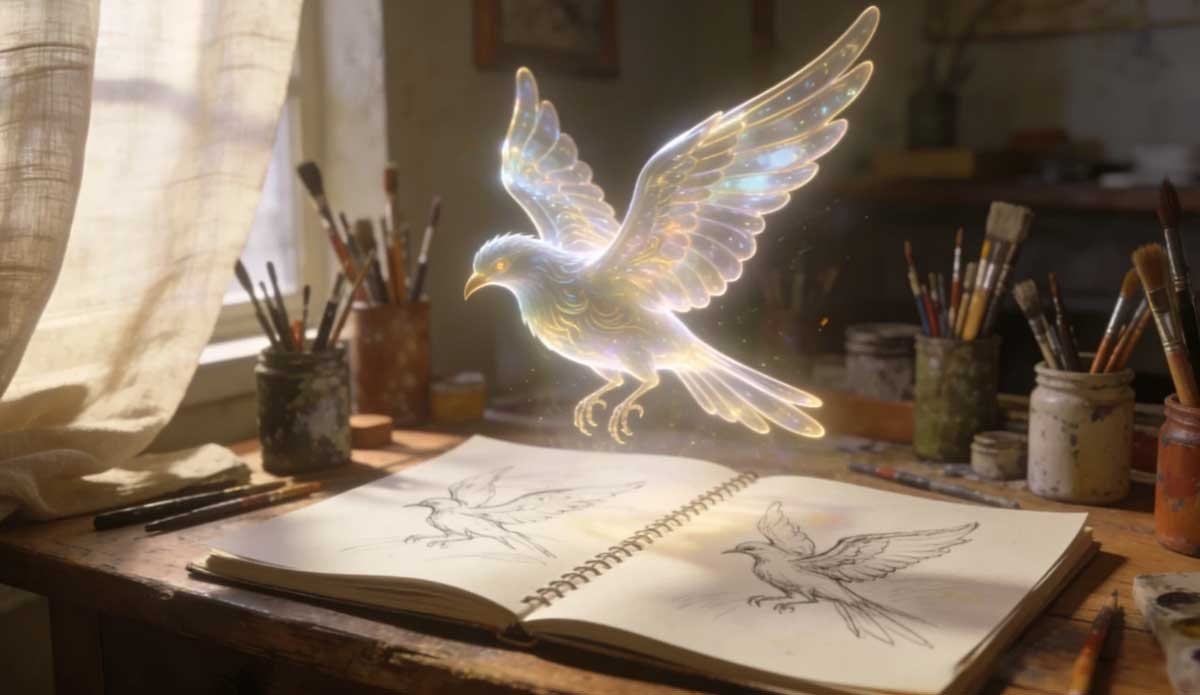
Every artist knows the feeling of looking at a cherished sketch and wishing they could step inside it. Whether it’s a character born from a midnight doodle or a landscape captured in a quick watercolor wash, our two-dimensional creations often feel like they’re waiting for something more, a sense of volume, a play of light, or the ability to be seen from every angle.
As we embrace the creative possibilities of 2026, the wall between a flat drawing and a tactile art piece is finally crumbling. With the help of three-dimensional creative tools, the journey from a simple concept to a vivid, sculptural reality has become as natural as picking up a brush.
Stepping Into the Third Dimension
For those of us who identify as “creatives” rather than “technicians,” the world of 3D modeling used to feel intimidating, a maze of complex buttons and sterile math. But the new wave of artistic AI is changing that narrative. It’s no longer about manual labor; it’s about vision.
Imagine taking a character you’ve drawn—perhaps a whimsical woodland creature or a bold fashion figure, and seeing it take shape in space. Neural4D acts as a bridge for this transition. By interpreting the intent behind your lines and shadows, it reconstructs your art into a form that has weight and presence. It’s not just a copy; it’s a transformation that happens in the blink of an eye, leaving you with a digital sculpture that feels like you could reach out and touch it.
Finding Magic in the Details
One of the most exciting shifts for visual storytellers is the ability to turn simple descriptions into tangible inspiration. If you can describe a dream, you can now see it in three dimensions. This leap is beautifully explored in this guide to artistic transformation, which shows how even the most abstract ideas can be given a physical soul.
The beauty of this modern process lies in its respect for the artist’s touch. The textures of your original paint, the unique grain of the paper, and the specific flow of your ink are preserved, not erased. Instead of a cold, robotic output, you get a digital asset that carries the warmth of your original creative spark. This allows crafters and designers to build entire galleries of their own work, where every piece feels consistent and uniquely personal.
The Freedom to Play and Iterate
Creativity is an iterative dance. We try, we change, and we grow. In the past, 3D work was too rigid for this kind of free-flowing play. Now, because the heavy lifting of building the “skeleton” of an object is handled by intelligent algorithms, you are free to focus on the aesthetics.
You can now generate dozens of variations of a concept, exploring different scales and perspectives without ever losing your momentum. Whether you’re designing a personalized gift, a character for a story, or a unique piece of digital jewelry, the process is now as fluid as a conversation. This democratization of depth means that the “curiously creative” among us are no longer limited by what we can draw; we are only limited by what we can imagine.
Conclusion: A New Canvas Awaits
We are entering a golden age of creative expression where the barriers between “thought” and “thing” are disappearing. By inviting 3D tools into our creative studios, we aren’t replacing the human hand; we are giving it more room to move. In 2026, your sketches are no longer just marks on a page; they are the beginning of a journey into a new dimension, one where every idea has the depth it deserves.